March Madness
I love basketball, so March Madness might be my favorite time of the year. Watching the 64 best teams in college basketball compete against each other in a single elimination tournament is absolutely electric. I think the amateur aspect of it makes it even more interesting. Nothing beats watching an unknown underdog defy the odds and pull off crazy upsets (Shout out 2013 Wichita State). However, I think my favorite part of everything might be making your bracket before the tournament.
The Perfect Bracket
My friends and I compete against each other every year to see who has the most accurate bracket, earning points for every correct prediction. Although none of us have ever come close to it, the holy grail for every sports fan is the perfect bracket. Picking all 63 games correctly has never been done in the history of the tournament, despite millions of brackets being made every year. This year, ESPN alone had 25.6 million entries for the men's tournament, and 3.5 million for the women's tournament. The closest that people have come to achieving a perfect bracket was in 2025 when one ESPN user predicted the first 57 games correctly for the women's tournament, which still fell 6 games short. For the men's tournament, someone managed to predict the first 49 games in 2019.
What Are The Odds?
Now we get to the point I want to make. Since there are 63 games in the tournament, there are 2^63 different ways the tournament could play out. That's about 9.2 quintillion possible outcomes. When people talk about how unlikely a perfect bracket is, they almost always use that number: a 1 in 9.2 quintillion chance. That's a 0.00000000000000001084% chance you pick every game right. You'd actually have a better chance picking out one specific grain of sand on the entire earth (a 1 in 7.5 quintillion chance).
However, it really bothers me when people reference the 9.2 quintillion number. The issue I have with this is that this line of thinking assumes that in any given matchup, either team has an equal chance of winning. This is far from the truth. Since the teams are already seeded by strength, we can easily decide to pick the more likely choice if we want a better chance at being right. Before the start of this year's men's tournament, out of the 160 matchups between 1 seeds and 16 seeds in the tournament's history there have only been two occasions where the 16 seed prevailed. This gives us a ~99% historical chance that the 1 seed wins. This clearly shows that the 1 in 9.2 quintillion chance isn't accurate. The women's tournament is even chalkier: Her Hoops Stats mathematical prediction gives each of the 1 seeds a >60% chance of winning their respective regions.
So, What Are The Actual Odds?
How can we calculate the actual odds of picking the correct bracket? Well, it depends how you make your picks.
The NCAA actually used the data from their Bracket Challenge to calculate the odds for the average person. They essentially took the average user's pick accuracy for every first round matchup and weighted those percentages to calculate what their average accuracy would be throughout the whole tournament, which turned out to be a nice 66.7% chance of picking a matchup correctly. The odds of a perfect bracket with a 66.7% chance to pick each matchup correctly would be (0.667)^63 ≈ 1 in 120 billion. This means the average person already picks at a rate that's about 77 million times better than picking at random.
Well what if you're not an average person? What if you're a basketball guru? Georgia Tech professor Joel Sokol might be the closest thing to that. He has been working on predictive models for NCAA basketball games, which he claims has an accuracy of about 75% for regular season games. What are the odds his model can achieve a perfect bracket then? For tournament games, it is likely that we would expect a lower accuracy from his model as there are factors in March Madness that wouldn't be present during the regular season. Still, even if we assume 75% accuracy for every game in the tournament, our odds shoot up dramatically. We go all the way to about (0.75)^63 ≈ 1 in 74 million.
| Predictor Type | Accuracy per Game | Odds of a Perfect Bracket |
|---|---|---|
| Random (Coin Flip) | 50% | 1 in 9.2 Quintillion |
| Average Fan | 66.7% | 1 in 120 Billion |
| Basketball Guru/Predictive Model | 75% | 1 in 74 Million |
Will There Ever Be A Perfect Bracket?
With the majority of bracket makers only getting about 66.7% of their picks correctly, it's still HIGHLY unlikely that we will ever see a fully perfect bracket. We can even calculate in how many years we can expect there to be at least a 50% chance that there has been a perfect bracket by solving for x in following equation:
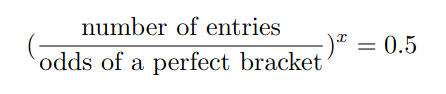
Even if we're really generous and assume 100 million entries with a 66.7% accuracy rate, it would take 832 years for there to have been a 50% chance that someone got it right. To put that in perspective, if 100 million people filled out brackets every year since 1194, we'd only just now have a 50/50 shot of having seen a perfect one. Also, since it's a memory-less distribution, meaning each year's results don't matter for the next, every year we don't get a perfect one the clock essentially restarts. So the odds that you'll impress everyone with your perfect bracket are extremely low. I do think that might be the whole reason we fill out our brackets every year though. It's fun to imagine you'll be the first one in history to get it right.